The Power of a Connected Waterfront: New Report
Toronto’s waterfront is growing rapidly, but fragmented transportation threatens its full potential. Coordinated action is needed to build a connected, accessible and economically vibrant waterfront, says a new report from Toronto Region Board of Trade created with the Waterfront Coalition.

Anyone who visits the Toronto waterfront will tell you: getting there isn’t always easy. Barriers to seamless travel persist in every direction and across every mode. Transit service remains fragmented along the length of the waterfront, and the Waterfront East LRT has faced years of delay. Gridlock is common on the Gardiner Expressway. Pedestrian routes from downtown and along the shoreline are difficult to navigate. And beyond the City of Toronto’s ferries to the islands, water-based transit has yet to develop at scale.
At the same time, growth along the waterfront is accelerating. The expansion of the Port Lands alone is expected to welcome 130,000 new residents and 50,000 new jobs. To the west, new recreational destinations are emerging, alongside the future southern terminus of the Ontario Line. Meanwhile, the downtown core, just minutes from the lake, continues to anchor Canada’s economy as the country’s financial capital.
Without an integrated transportation network that keeps pace with this growth, Toronto risks not only missed economic opportunity, but also the very real threat of stagnation as movement becomes more difficult for everyone.
A new Toronto Region Board of Trade report, The Power of Connection, calls for urgent action to improve mobility across the waterfront, to better support residents and visitors, strengthen economic competitiveness and avoid the cost of inaction.
Our waterfront is one of Toronto’s most significant economic, cultural and recreational assets. Yet transportation within and across this district remains underdeveloped. Unlocking its full potential will require a coordinated effort among governments and private-sector partners to deliver solutions that embrace all modes of travel and future-focused technologies, and a goal of enhancing public access to key areas of activity.
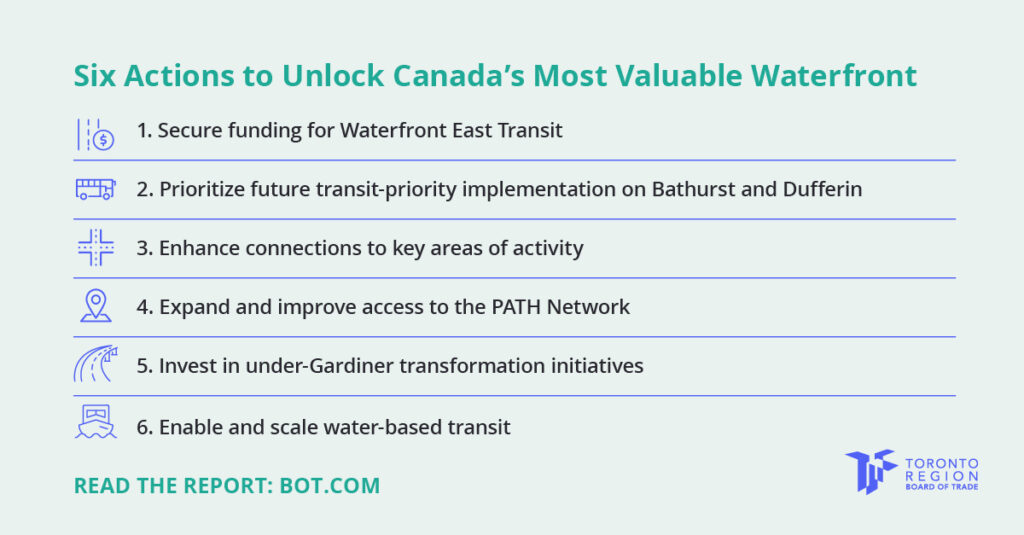
The report outlines six recommendations to improve transit, link destinations more effectively, enhance connections to downtown and seize opportunities for innovative mobility and placemaking.
As owners of Billy Bishop Toronto City Airport and Toronto’s only cruise ship terminal—which now welcomes approximately 20,000 visitors annually—we have a strong interest in ensuring that transportation and mobility remain priorities for the waterfront as it evolves. While the airport is already served by some TTC transit routes and valued for its central location, we envision a future where people can move more seamlessly among the parks, schools, businesses, cultural attractions, beaches, galleries, restaurants and and the many new enterprises and amenities emerging within growing communities.
Part of that future lies in making better use of the water itself. We are working with Hoverlink to advance plans for a Niagara–Toronto hovercraft service departing from the west bayfront, and we look forward to participating in Waterfront Toronto’s water taxi pilot next summer linking destinations on the east and west of the harbour.
There is so much to discover along our waterfront. Yet today it remains underutilized, limited by gaps in mobility and a lack of integrated transportation options that match the scale of its potential.
This must change. In the years ahead, we will continue to work with waterfront stakeholders, government partners, funders, and private industry to modernize infrastructure, expand mobility choices, and test new ways of getting around, guided by our strategic plan, Transportation Reimagined.
The Power of Connection was developed with input from the Waterfront Coalition, of which PortsToronto is a member, alongside Waterfront Toronto, George Brown College, Harbourfront Centre, CreateTO, the Waterfront BIA, Nieuport Aviation, Exhibition Place and The Bentway.